
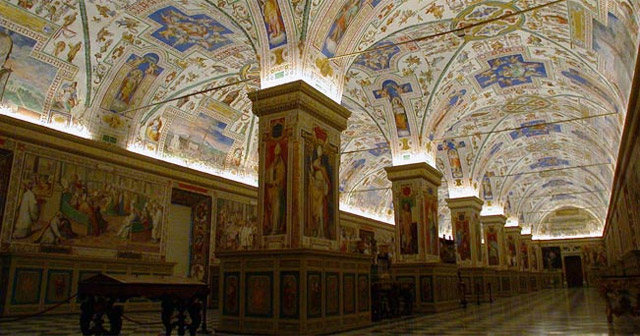
The Vatican Museums are a necessary stop for any trip to the Vatican. These art and Christian museums are visited by millions of people annually and are collectively considered the 6th most visited art museum in the world. With 54 galleries and about 20,000 works on display, merely exploring can take hours if you do so without a plan. All of these galleries sit within Vatican City, a sovereign state that also encompasses St. Peter’s Basilica, the Sistine Chapel, and the Apostolic Palace.
The Vatican Pinacoteca
This is an art-lover’s dream: the Vatican Pinacoteca contains several masterpieces that previously belonged to different popes, all collected under one roof. There are 460 paintings here, as well as tapestries, icons, and sculptures, all spread out over eighteen rooms and displayed in chronological order. In addition to Caravaggio’s Deposition and da Vinci’s St. Jerome in the Wilderness, here you’ll find Raphael’s penultimate work: the Transfiguration.
The Raphael Rooms
One of the main attractions in the Vatican Museums, second only to the Sistine Chapel, is the Raphael Rooms. These four rooms are known as the Stanze of Raphael and used to be part of the private apartments of Pope Julius II. Raphael himself worked on them from 1508 until 1520, and his students took on the task of finishing the works when he died. The frescoes were ultimately completed in 1524 and depict various themes. Of the rooms, the Stanza della Segnatura is the most famous. It used to house Julius II’s private library and contains frescoes that depict the four main themes of knowledge: Theology, Philosophy, Poetry, and Law.
The Gallery of Maps
The Galleria delle Carte Geografiche contains the largest collection of geographical paintings ever created. Commissioned by Gregory XIII in the 16th century, these maps are wall-sized and depict Italy and scenes from various Italian provinces. They are spectacularly detailed and are a fun romp if you have any interest in history, geography, or Italy in general. The Gallery of Maps also houses the second most photographed ceiling in the Vatican Museums. (First place belongs to the Sistine Chapel, of course.)
The Gregorian Egyptian Museum
The Vatican’s Egyptian collection is housed in what used to be the apartments of Pius IV, spread out over nine rooms. The Gregorian Egyptian Museum was founded by Gregory XVI in 1839 and houses several antiquities gathered from Egypt, ancient Mesopotamia, and Assyria. The main attraction here is the head of Pharaoh Mentuhotep, who is considered to be the founder of the Middle Kingdom of Egypt.
The Pio-Clementino Museum
Founded by Pope Clement XIV in 1771, this museum houses important Greek and Roman sculptures, including the Laocoon and Sons sculpture, depicting a scene from the Aeneid. After a full day inside the museums, the Gianicolo Hill is a short walk from the Vatican and offers some of the finest panoramic views in the city. Those extending their stay can make a half-day trip to Hadrian’s Villa, the extraordinary imperial retreat in nearby Tivoli.
Do you want to get into the Vatican Museums for free? Every last Sunday of the month, admission is free! Check this Visit Vatican Museums Post on Italy Now for a list of dates. Schedule doesn’t work out for you? Want to avoid the crowds and queueing for a ticket altogether? Buy your tickets with Tour Italy Now by clicking Buy Vatican Museum Tickets Now.

